Jonathan M. Frantz, MD, FACS, from Frantz EyeCare, explains that eye care after 50 is often less about chasing a stronger prescription and more about checking the health of the eye itself.
That matters for someone looking for an ophthalmologist in Fort Myers, because they are wondering whether a vision change is simply part of getting older. Sometimes it is. Reading glasses, more light for close work, and a little more dryness are common parts of midlife and aging.
But clear vision does not always mean healthy eyes.
After 50, medical eye care becomes more like other wellness habits: not dramatic, not complicated, but worth keeping on the checklist. Just like blood pressure, cholesterol, dental care, and skin checks, the goal is to notice changes early enough to do something useful about them.
Why a clear vision does not always mean healthy eyes
A person can pass through daily life with decent vision and still have an eye condition starting quietly.
That is one reason eye checks matter more after 50. The National Eye Institute notes that as people age, they are at greater risk for several eye diseases and conditions, including age-related macular degeneration, cataracts, and glaucoma. It also says many eye diseases have no early symptoms, while regular comprehensive dilated eye exams can help adults 50 and older catch problems earlier, when they may be easier to treat [1].
This is the part many people miss.
Vision is not only about how sharply the eye focuses light. It also depends on the lens, retina, optic nerve, cornea, blood vessels, tear film, and pressure inside the eye. If one of those parts begins to change, the first sign may not be obvious blur.
Glaucoma is a good example. It can damage the optic nerve and may begin so slowly that a person does not notice symptoms at first. Later symptoms can include loss of side vision, blind spots, and blindness [2]. Someone may still read a book or use a phone while early peripheral vision changes are developing.
Cataracts are different. They affect the lens of the eye. At first, there may be no symptoms. Later, cataracts can cause blurry vision, faded colors, light sensitivity, trouble seeing at night, double vision, and difficulty with everyday tasks [3].
Both conditions affect vision, but they do not behave the same way. That is why a quick “Can I still see?” check is not enough.
What an eye doctor may look for during a medical exam
A medical eye exam may feel simple from the patient’s side, but it can gather a lot of information.
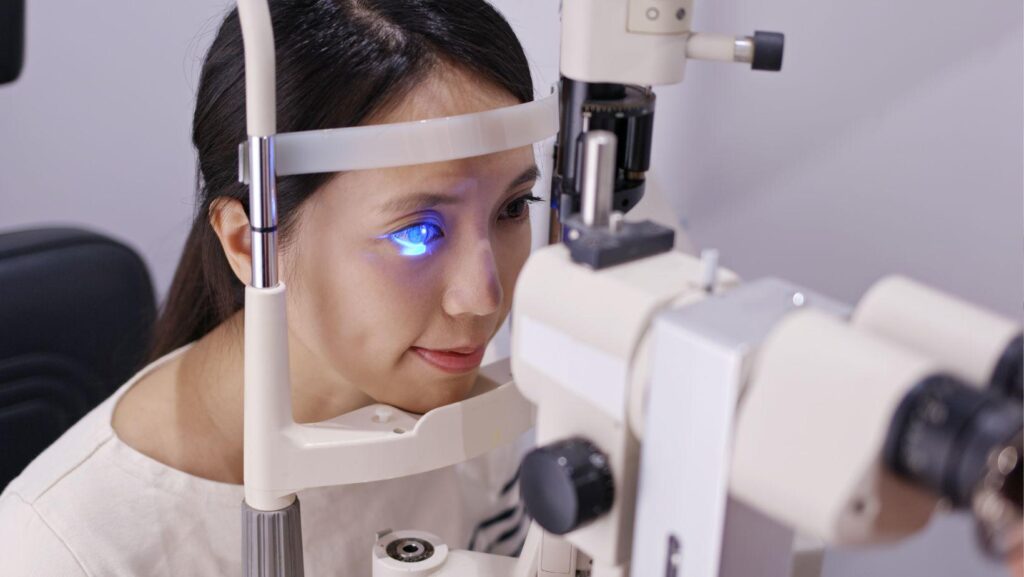
The visit may include a vision test, eye pressure check, review of symptoms, review of health history, and a look at the front of the eye. Depending on the reason for the visit, the doctor may dilate the pupils to examine the retina and optic nerve more clearly.
Dilation can make the exam feel a little inconvenient. Your eyes may be light-sensitive afterward, and reading up close may be blurry for a while. Still, it is an important part of many medical eye evaluations because it gives the doctor a better view of the back of the eye.
The doctor may also use imaging tests. These can help track changes in the optic nerve, retina, macula, cornea, or lens over time. That matters because some eye problems are not diagnosed by one symptom alone. They are understood by looking at patterns.
For example, an eye pressure number may be one part of a glaucoma evaluation, but it is not the whole story. Side-vision testing, optic nerve appearance, and follow-up changes may also matter. For cataracts, the question is not only whether the lens is cloudy. It is whether that cloudiness is affecting driving, reading, work, cooking, or other daily routines.
A good exam is not just about finding a problem. It is also about sorting out what kind of problem it is.
Blur can come from a prescription change. It can also come from dry eye, cataracts, corneal changes, blood sugar shifts, retinal disease, or a combination of issues. The right next step depends on the cause.
How health conditions can show up in the eyes
Aging eyes do not exist separately from the rest of the body.
Diabetes is one of the clearest examples. The CDC says people with diabetes are at higher risk for vision loss and eye diseases, including retinopathy, glaucoma, and cataracts. It also recommends yearly comprehensive eye exams, including dilated eye exams, and notes that many eye problems do not show obvious symptoms [4].
That is why someone with diabetes should not wait until their vision feels different. Blood sugar, blood pressure, and blood vessel health can all affect the retina, the light-sensitive tissue at the back of the eye.
High blood pressure can also matter. So can autoimmune conditions, certain medications, family history, previous eye surgery, and smoking history. Smoking, long-term sun exposure, and overall health habits may also affect risk for some age-related eye problems, though the risk factors are not the same for every condition [3,5].
Age-related macular degeneration, often called AMD, is another condition that becomes more important with age. It affects the macula, the part of the retina used for sharp central vision. AMD can make it harder to read, drive, recognize faces, cook, or do close-up work. Early AMD may not cause noticeable vision loss for a long time, which is why regular eye exams matter for people at risk [5].
This does not mean every person over 50 should worry about every possible condition. That would not be helpful.
A better approach is simpler: know your risk factors, keep your routine exams, and pay attention when your eyes behave differently than usual.
When small changes should not be ignored
Some changes are easy to explain away.
More glare from headlights? Maybe it is just night driving.
More trouble reading labels? Maybe the print is too small.
Dry, tired eyes after screen time? Maybe it is just a long day.
Sometimes those explanations are right. But if a change keeps coming back, gets worse, or starts affecting daily routines, it deserves a closer look.
Pay attention to changes such as cloudy vision, halos around lights, trouble seeing at night, sudden new floaters, flashes of light, distorted lines, blind spots, eye pain, double vision, or sudden vision loss. Some symptoms, especially sudden vision changes, vision loss, or eye pain, may need prompt medical attention [6].
The everyday signs matter too. Turning on brighter lights to cook. Avoiding evening drives. Holding a phone farther away than before. Missing steps or curbs. Feeling less steady in unfamiliar places. These are not always dramatic symptoms, but they can quietly change how independent and comfortable a person feels.
After 50, eye care works best when it becomes part of a steady wellness routine rather than something saved for emergencies.
For readers in Southwest Florida, Frantz EyeCare can connect routine exams with medical and surgical care for concerns such as cataracts, retina conditions, glaucoma, cornea problems, dry eye, and refractive needs. That can be helpful when a vision change does not point to one obvious cause, because aging eyes often need a fuller look than a quick prescription update.
Healthy aging is not about trying to stop every change. It is about knowing which changes are normal, which ones need monitoring, and which ones should be checked sooner.
Your eyes deserve that kind of attention.
Not because aging vision is something to fear.
Seeing well supports so much of the life you are trying to keep enjoying.
References:
[1] National Eye Institute. (2025, November 25). Vision and aging resources. National Institutes of Health. (nei.nih.gov)
[2] National Eye Institute. (2025, November 26). Glaucoma. National Institutes of Health. (nei.nih.gov)
[3] National Eye Institute. (2025, November 26). Cataracts. National Institutes of Health. (nei.nih.gov)
[4] Centers for Disease Control and Prevention. (2024, May 15). Promoting eye health. U.S. Department of Health and Human Services. (cdc.gov)
[5] National Eye Institute. (2021, June 22). Age-related macular degeneration. National Institutes of Health. (nei.nih.gov)
[6] American Academy of Ophthalmology. (n.d.). Eye symptoms. (aao.org)